
This is the third of three articles examining the natural resource cost of AI infrastructure. Part 1 explored AI’s hidden water problem. Part 2 examined AI’s dependence on fossil fuels and the energy infrastructure gap. This article closes the series with the minerals question: what the ground has to give up for AI hardware to exist.
The hardware behind Artificial Intelligence
AI feels like thought. It presents itself as language, as image, as prediction. Weightless outputs from an invisible process. But behind every trained model and every answered query sits physical hardware: servers, chips, cooling systems, power infrastructure, and the cables and components that connect them. That hardware is not conjured. It is manufactured. And manufacturing it requires materials that must be located, extracted, processed, and shipped from specific locations on Earth before a single rack is installed in a data center. These materials are AI’s critical minerals.
From a geoscientist’s perspective, the relevant question is not how these materials are assembled into finished hardware. It is what the ground has to give up to produce them in sufficient quantity to meet a demand that is accelerating faster than at any point in the history of the semiconductor industry.
The mineral list is not abstract. Copper conducts electricity through every power distribution system, networking cable, and cooling circuit in a data center — the IEA projects that AI data centers alone could consume between 512,000 and 550,000 metric tons of copper annually by 2030. Lithium and cobalt anchor the battery backup systems that keep facilities running during grid interruptions. Nickel and manganese support energy storage infrastructure. Silicon, refined from quartz, is the substrate of every semiconductor. And rare earth elements (neodymium, dysprosium, and terbium among them) are essential to the permanent magnets that drive the cooling systems and electric motors that data centers depend on to manage heat at scale.
Each of these materials has a geology. Each has a geography. And each has a supply chain that is more constrained, more concentrated, and more geopolitically exposed than the AI industry’s public narrative acknowledges.

The scale of AI’s critical minerals demand
The AI hardware buildout is not a modest increment to existing mineral demand. According to the IEA’s Global Critical Minerals Outlook 2025, demand for key energy transition minerals is set to grow rapidly across all scenarios. Under the IEA’s Stated Policies Scenario, lithium demand grows fivefold by 2040, graphite and nickel demand double, and cobalt and rare earth demand increase by 50 to 60 percent. Copper — the material with the largest established market — is projected to grow by 30 percent over the same period.
AI is a meaningful driver of that trajectory. Data centers globally consumed 415 terawatt-hours of electricity in 2024, with consumption projected to approach 1,000 terawatt-hours by 2030. Every component of that infrastructure (from transformers and power cables to server racks and cooling systems) carries mineral intensity that compounds at scale.
Copper illustrates the pressure most clearly. The IEA projects a 30 percent copper supply deficit by 2035 relative to announced project pipelines, with demand rising from 27 million tonnes in 2024 toward 33 million tonnes by 2035 under current policy settings. Mine development timelines now average 17 years. Only 14 new copper deposits have been discovered in the past decade, compared to 225 in the 23 years before that. AI data centers alone could consume between 250,000 and 550,000 metric tons of copper annually by 2030 — representing 1 to 2 percent of total global demand. The industry is not positioned to meet this without substantial new exploration and development.
Where these critical minerals come from
The supply picture for critical minerals is defined by geographic concentration that creates genuine risk for any developer or investor thinking seriously about supply chain resilience.
For instance, cobalt, essential to battery backup systems in data centers, is sourced overwhelmingly from the Democratic Republic of Congo (DRC), which accounted for approximately 76 percent of global cobalt mine supply in 2024, according to CSIS. Chinese companies hold ownership stakes in 15 of the DRC’s 19 operating cobalt mines. In early 2025, the DRC imposed a cobalt export ban, and later a quota system capping exports at roughly half of 2024 production levels, sending prices surging by 48 percent within weeks and demonstrating precisely how quickly a single-country dependency can translate into acute supply disruption.
Rare earth elements present an even starker picture. China accounted for approximately 69 percent of global rare earth mine production in 2024. Its dominance at the processing and refining stage is far greater: the IEA estimates China controls approximately 91 percent of global rare earth separation and refining capacity and 94 percent of sintered permanent magnet production, the magnets used in data center cooling systems, electric motors, and defense applications. In 2024 and 2025, China imposed successive waves of export controls on rare earths and related processing technology, simultaneously disrupting supply chains for defense, semiconductor, and AI hardware manufacturers.
For gallium and germanium — minerals used in fiber-optic systems and advanced semiconductors essential to data center infrastructure — AI-specific demand is projected to increase consumption by 85 percent and 37 percent, respectively, by 2033, according to FP Analytics. The supply risk here is not hypothetical. It is already materializing as price spikes, stockpiling, and emergency sourcing efforts by major technology companies.
This concentration prompted the United States to expand its Critical Minerals List in 2025 to 60 minerals, designating domestic supply as a national security priority. An AI infrastructure buildout that depends on materials sourced almost entirely from geopolitically exposed supply chains has fragility built into its foundation.
The critical mineral extraction reality
Getting critical minerals out of the ground at the scale AI infrastructure demands is energy- and water-intensive and, when carried out without adequate geological understanding of the deposit, inefficient in ways that compound both environmental and economic costs.
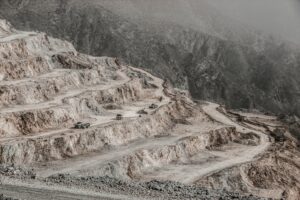
Hard rock lithium mining requires significant excavation and processing. Cobalt extraction in the DRC has drawn sustained scrutiny from human rights and environmental organizations. Rare earth processing generates waste streams that require careful management. Copper porphyry deposits, among the most economically significant ore types in the Americas, require the removal of enormous volumes of low-grade material to reach economically viable concentrations. Copper ore grades have declined by approximately 40 percent since 1991, meaning more rock must be moved per tonne of copper recovered.
None of this means critical mineral extraction cannot be done responsibly. It means that responsible extraction (extraction that is efficient, defensible, and capable of meeting the standards that investors, regulators, and host communities increasingly require) starts with a rigorous, geoscience-based understanding of the deposit before a single drill hole is committed.
Exploration programs guided by integrated geophysical and geological investigation waste less rock, use less water, disturb less surface area, and generate more actionable results per exploration dollar spent. The alternative — drilling based on surface observations alone, or applying broad-coverage survey methods that are not calibrated to the specific geology of the project — produces inconclusive results at a cost that compounds quickly when capital is finite, and timelines are under pressure.

The domestic opportunity and the subsurface question
The strategic imperative to develop domestic and nearshore critical mineral supply is generating real exploration activity across the United States and Mexico, and with it, real demand for the kind of subsurface investigation that separates a viable deposit from an expensive disappointment.
Mexico’s geological endowment makes it a significant part of this picture. According to USGS data, Mexico ranks among the world’s top producers of copper, graphite, antimony, and several other critical minerals. The updated US Critical Minerals List includes materials that Mexico produces or has significant reserves of: copper, silver, lithium, graphite, molybdenum, zinc, and manganese. Northern Mexico, in particular, is emerging as a focus of exploration activity, with geological environments in Sonora and adjacent states hosting copper porphyry systems, silver-polymetallic deposits, and lithium-bearing formations that are attracting renewed investment in response to the demand signal from technology and energy markets.
The US-Mexico corridor lies within geological provinces known to host significant critical-mineral potential. The Basin and Range province, extending from the American Southwest into northern Mexico, contains environments prospective for copper, lithium, and associated minerals. But surface geology tells only part of the story. The deposits that matter most, the ones with the grade, geometry, and structural setting that make them economically viable, are defined by what lies beneath. And what lies beneath cannot be assumed. It has to be investigated.
Multi-method geophysical surveys, combining passive and active electromagnetic methods, geo-electrical (resistivity and induced polarization), magnetics, radiometrics, gravity, and, to a lesser extent, seismic techniques, depending on the target type and geological setting, provide the subsurface imaging needed to identify which areas within a project have characteristics consistent with mineral potential, and which do not. That discrimination is the foundation of a capital-efficient exploration program. Without it, drilling is expensive guesswork. With it, every drill hole is informed by a geological model that has been tested against multiple independent lines of subsurface evidence.
The IEA notes that new mining projects currently require an average of 16-17 years from discovery to production. That timeline makes front-end investment in rigorous exploration even more consequential. Every year saved in the early-stage investigation phase — through better survey design, better geological interpretation, and tighter discrimination between prospective and non-prospective ground — is a year closer to the production that critical mineral markets urgently need.
Closing the loop: Water, energy, minerals
AI’s physical footprint is larger than the industry’s public narrative acknowledges. It consumes water at a scale already straining aquifers across the American Southwest. It runs on electricity still predominantly generated from fossil fuels, at a pace the clean energy transition has not yet matched. And it depends on minerals that have to be found, extracted, and processed from specific geological environments — environments whose subsurface conditions determine whether that extraction is viable, efficient, and defensible.
The common thread across all three dependencies is the same: the answers lie below the surface. Water availability is a subsurface question. Energy infrastructure siting is a subsurface question. Critical mineral exploration is, by definition, a subsurface question.
The developers, investors, and infrastructure planners who understand that (and who invest in the geoscience needed to answer those questions before commitments are made) are the ones building on ground that is actually understood. That is not a minor operational detail. It is the difference between infrastructure that performs as planned over a 20- to 30-year horizon and infrastructure that discovers its constraints too late to address them cost-effectively.
AI’s resource problem is geological at its root. And geological problems, as any geoscientist will tell you, require geological answers.
Is your critical minerals project built on solid subsurface knowledge?
Whether you are evaluating a copper porphyry system, assessing lithium potential in a basin setting, or characterizing a rare earth or polymetallic prospect in the US-Mexico corridor, CGS brings certified geoscience expertise, a multi-method geophysical approach, and deep familiarity with the geological environments of Texas, the broader US Southwest, and northern Mexico.